In short
guide to the festivals of India, month by month: which ones to structure a trip around, where to see them, and what moving dates mean for planning.
At a glance
- Festival peak
- October – November is the strongest overall festival window
- Early year
- January – March combines cool weather with harvest festivals, Maha Shivaratri and Holi
- Hot season
- April – June has real regional festivals but serious heat across the plains
- Monsoon season
- July – September shifts the strongest festival logic toward regional events in the west and south
When to go
Cool weather and mid-January harvest festivals make this a strong festival-travel month.
Comfortable weather continues, with Maha Shivaratri sometimes falling in late February.
Holi anchors the month, though North India begins warming quickly by late March.
Regional new years and Baisakhi add interest, but rising heat starts to constrain demanding northern routes.
The plains are very hot, so festival planning works better in selective regions and higher elevations.
Heat remains the main planning constraint even where regional festivals continue.
Monsoon conditions shift the festival focus toward regional events and the south.
Onam and other monsoon-period traditions can justify travel when the route is built around the season.
Regional festival travel remains rewarding, including Ganesh Chaturthi and Kerala celebrations.
Cooler northern weather returns as Dussehra, Navratri and often Diwali drive the festival peak.
Diwali-season travel and the Pushkar Camel Fair make this one of the year’s strongest festival months.
Cool weather and Christmas in Goa and southern Christian communities give December a gentler cultural calendar.
January: Best time — Cool weather and mid-January harvest festivals make this a strong festival-travel month.
February: Best time — Comfortable weather continues, with Maha Shivaratri sometimes falling in late February.
March: Best time — Holi anchors the month, though North India begins warming quickly by late March.
April: Shoulder — Regional new years and Baisakhi add interest, but rising heat starts to constrain demanding northern routes.
May: Off-season — The plains are very hot, so festival planning works better in selective regions and higher elevations.
June: Off-season — Heat remains the main planning constraint even where regional festivals continue.
July: Shoulder — Monsoon conditions shift the festival focus toward regional events and the south.
August: Shoulder — Onam and other monsoon-period traditions can justify travel when the route is built around the season.
September: Shoulder — Regional festival travel remains rewarding, including Ganesh Chaturthi and Kerala celebrations.
October: Best time — Cooler northern weather returns as Dussehra, Navratri and often Diwali drive the festival peak.
November: Best time — Diwali-season travel and the Pushkar Camel Fair make this one of the year’s strongest festival months.
December: Reliable — Cool weather and Christmas in Goa and southern Christian communities give December a gentler cultural calendar.
Festivals of India: A Traveller's Guide to the Year
India does not have a festival season. It has a festival calendar that runs the entire year, because the country is not one culture observing one set of holidays but many cultures, faiths, and regions, each with its own. A harvest being celebrated in Tamil Nadu in January has nothing to do, in origin, with the one being celebrated in Punjab the same week, and both differ again from the lunar new year observed in Assam. The result is that on almost any week of the year, something significant is happening somewhere in the country.
For a traveller, this is one of the most rewarding ways to experience India, and one of the easiest to get wrong. A festival can turn a good trip into a remarkable one, or it can mean closed sites, full hotels, and roads that do not move. The difference is entirely in the planning, and that is the part worth getting right before you go.
This guide is a way of reading the Indian festival year, the major celebrations worth knowing, and then a month-by-month sense of what falls when. It is written for travellers deciding when to come and for advisors building a trip around a date that matters. One caution to hold throughout: most Indian festivals follow lunar or solar religious calendars, so their dates move against the Western calendar every year. The months below are reliable. The exact dates need confirming for your specific year, and that confirmation should happen before anything is booked.
The Major Festivals Worth Planning Around
A handful of festivals are large enough, and distinctive enough, that they are worth building a trip around rather than simply catching if you happen to be there.
Diwali, the festival of lights, is the closest India has to a single national festival, observed across faiths and regions over several days in the autumn, usually October or November. Homes and streets are lit with oil lamps and lights, there are sweets and family gatherings, and the mood is closer to Christmas in the West than to anything else, in the sense that it is the emotional centre of the year for many people. For a traveller it is genuinely special, and it is also the single most demanding time to travel: domestic flights and trains fill weeks ahead, hotels charge peak rates, and many businesses close as people return to their home towns. It rewards planning a long way out.
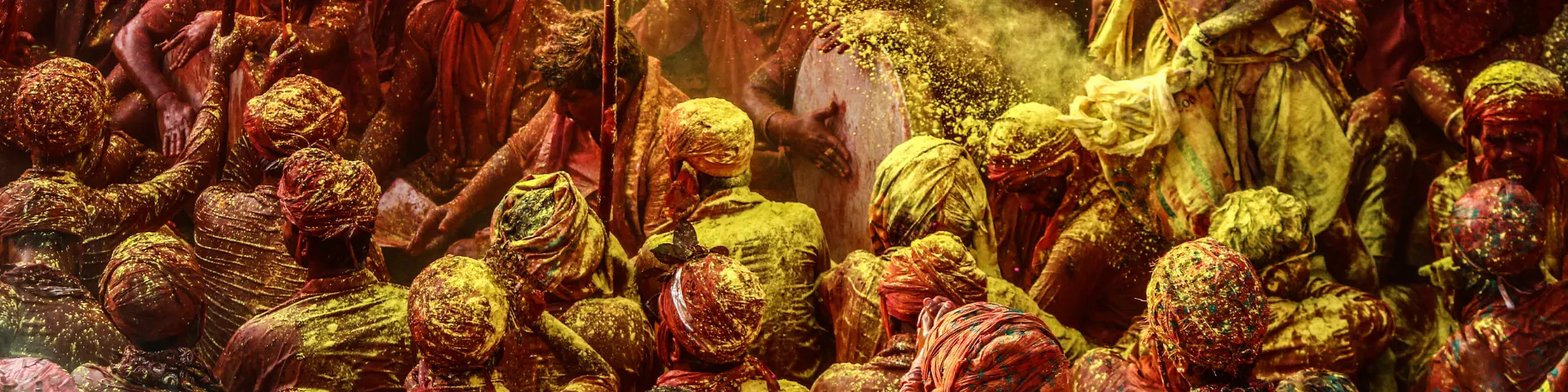
Holi, the spring festival of colour, falls in March and is the one most international travellers picture: streets full of people throwing coloured powder, music, an atmosphere of release. The night before is marked with bonfires. It is joyful and welcoming and worth experiencing once, with two operator notes. The celebration is physical and chaotic in the best sense, so it suits travellers who want to be in it rather than watching from a distance. And where you spend it matters enormously: Mathura and Vrindavan, near where the tradition is rooted, are the most intense and traditional; Pushkar and Udaipur are more traveller-friendly; a good hotel will often run its own controlled celebration for those who want the colour without the crowd.
Dussehra and Navratri run together across nine nights into a tenth day, usually in October, marking the victory of good over evil. The way it is celebrated changes completely by region, which is the interesting part: in Gujarat it is nights of garba dancing; in Kolkata it becomes Durga Puja, one of the great cultural events of eastern India, with the city transformed by elaborate temporary pavilions; in the north it ends with huge effigies of the demon king Ravana burned in public grounds. One festival, several genuinely different experiences depending on where you stand.
The Pushkar Camel Fair in Rajasthan is a different kind of event, a livestock fair in the desert in November that has become one of the most photographed gatherings in India, with thousands of camels and traders, folk performances, and a sacred lake bathing at its culmination. It is seasonal, it is rural, and it rewards staying in the tented camps near the fairground rather than commuting to it.
Alongside these sit the great religious observances of India's other faiths, Eid marking the end of Ramadan for the country's large Muslim population, Guru Nanak's birth anniversary and the Sikh festivals, Christmas in Goa and the southern Christian communities, the Jain and Buddhist observances. India's festival year is not a Hindu calendar with additions. It is genuinely plural.
January to March: Harvests, Colour, and the Best Weather
The early months of the year are among the best for travelling in India, with cool, clear weather across most of the country, and they open with a cluster of harvest festivals in the middle of January that mark the sun's northward turn.
These harvest festivals are the same moment celebrated under different names and customs across regions, which makes them a lovely illustration of how India works: Pongal is the four-day Tamil harvest festival in the south, with rice cooked fresh as an offering; Makar Sankranti is marked across Gujarat and Maharashtra, with the skies over Gujarat famously filled with kites; Lohri is the Punjabi bonfire festival in the north; Magh Bihu is the Assamese harvest in the northeast. If you are in the country in mid-January, it is worth being somewhere that does one of these well, and Gujarat during the kite festival is a particularly good piece of timing for a trip.
Late February or early March brings Maha Shivaratri, a major night of observance at Shiva temples, which is worth seeing in a temple town. Then March brings Holi, covered above, and with it the practical turn of the year: by late March the north is warming quickly, and the comfortable window for travelling the plains and Rajasthan begins to close.
This stretch, January into March, is the period we most often build festival-led trips around, simply because the weather and the festival density line up so well.
April to June: Regional Festivals and Rising Heat
The hot months are the quietest stretch of the festival year for the traveller, and the hardest for weather across most of the country, but they are not empty.
April opens the year for several regional calendars. Baisakhi is the Punjabi spring harvest and Sikh new year, vivid in the north. Various regional new years fall in this window across Tamil Nadu, Kerala, Assam, and Bengal. Ram Navami marks the birth of Lord Rama, observed at temples nationwide. Buddha Purnima, the Buddha's birth anniversary, is meaningful in the Buddhist centres and the Himalayan regions.
The operator reality of this season is straightforward. The festivals are real and often deeply traditional, but the heat across the plains is serious, and these are not months to build a demanding festival itinerary through northern India. Where this window genuinely works is in the high Himalayan regions, which are entering their own season as the plains become difficult, and where monastery festivals begin to appear. For most festival-led travel, though, April to June is the season to plan around the heat first and the festival second.
July to September: Monsoon Festivals and the South
As the monsoon settles over the country, the festival calendar shifts toward the west and south, and toward some of the most distinctive regional celebrations of the year.
This is the season of several of India's most characterful festivals. The Rath Yatra in Puri, on the eastern coast, sees enormous temple chariots pulled through the streets by huge crowds. Onam, in Kerala, is the great harvest festival of the south, ten days of flower arrangements, feasts served on banana leaves, and the famous snake-boat races, and it is one of the best reasons to be in Kerala at this time of year. Janmashtami, marking Krishna's birth, is celebrated with particular intensity in Mathura and Vrindavan and in Maharashtra. Ganesh Chaturthi, toward the end of this window, transforms Mumbai and Maharashtra as clay images of the elephant-headed god are installed, celebrated for days, and finally carried in vast processions to be immersed in the sea.
The planning logic here is to follow the festivals to where the season works. The monsoon makes some regions difficult, but Kerala during Onam and Maharashtra during Ganesh Chaturthi are genuinely rewarding, and the rain is part of the texture rather than only an obstacle. These are trips for travellers who want a festival that is regional and rooted rather than national and familiar.
October to November: The Heart of the Festival Year
If there is a single best window to come to India for festivals, this is it. The weather across the north turns cool and clear, the monsoon has cleared the air and greened the country, and the two largest festival complexes of the year, Dussehra and Diwali, fall within weeks of each other, with Pushkar's camel fair close behind.
This is the period when the whole country feels lit up, and it is the window we field the most festival enquiries about for good reason. Durga Puja transforms Kolkata into something that has to be seen to be understood. Dussehra plays out differently in every region. A few weeks later Diwali brings the entire country into light. Then, in November, the Pushkar fair, and in Varanasi the extraordinary Dev Deepavali, when the river ghats are lined with tens of thousands of lamps.
The operator note for this window is the same as its appeal: everyone wants to be here now, including domestic travellers in very large numbers. This is the most demanding season to secure the right hotels and internal travel, and the lead time is long, often the better part of a year for the best properties around the marquee dates. It is the most rewarding festival travel in India and the least forgiving of late planning. The two facts are connected, and the way to enjoy the first is to respect the second.
December: The Quiet Close and the South
December is the calmest end of the festival year across most of the country, and one of the most comfortable months to travel, with cool weather in the north and pleasant conditions in the south.
The headline is Christmas, which is a genuine and joyful event in Goa and across the southern Christian communities of Kerala and Tamil Nadu, with midnight mass, decorations, and a distinctly Indian warmth to the celebration. It coincides with the peak of the Goa season and the best weather of the year there. In the far south, the great Carnatic music and dance season runs through December and into January, especially in Chennai, which is a quieter, more refined kind of cultural festival for travellers drawn to the classical arts.
December is a good answer for a traveller who wants the comfort of the cool season and a gentler cultural texture rather than the full intensity of the October-November peak. It is also, not incidentally, one of the easier windows to plan well, which after the demands of the festival high season is worth something.
How to Travel India's Festivals Well
The single most useful idea to carry into festival planning is that a festival is both an opportunity and a constraint, and the good trips treat it as both.
As an opportunity, a festival gives a trip a centre of gravity, a reason to be in a particular place at a particular time, and an experience that is almost impossible to have any other way. Building a journey around Diwali in a heritage city, or Onam in Kerala, or the Pushkar fair, gives the whole trip a spine. As a constraint, the same festival means competition for hotels and transport, sites that may be closed or crowded, and dates that move from year to year and must be confirmed before anything is committed. Holding both of those in mind at once is the whole craft of it.
Three practical principles follow from that. Confirm the date first, because the festival moves and everything else is built on it. Book early for the marquee festivals, because the best properties around Diwali and the October-November peak go many months out. And choose your vantage point deliberately, because most major festivals offer a range from the most intense and traditional setting to a calmer, more curated one, and the right choice depends entirely on the traveller rather than on which is objectively best.
This is the part of festival travel that rewards working with people who do it every year. Knowing that Holi in Mathura is a different proposition from Holi in Udaipur, that Diwali hotel inventory in Jaipur is gone by spring, that Onam is worth the monsoon and a temple town in May is not, is the kind of pattern recognition that turns a festival from a gamble into the best part of a trip.
This guide covers India. It is the first of a series, with the festivals of Nepal, Bhutan, and Sri Lanka to follow, each with its own distinct calendar and its own logic.
Thinking about building a trip around one of India's festivals? [link: tell us what you have in mind → https://www.farboundtravels.com/plan-your-trip]
Good to know
Sources
- Farbound Travels — title, excerpt and guide content supplied in this row
Written by Salil Tiwari.
Published June 2026 · Last updated September 2026
Keep reading
Luxury Golden Triangle India: What Is Actually Worth Upgrading?
A high-end Golden Triangle trip is not improved by upgrading every line item. Here is where bet...
Best Tiger Safari in India: Ranthambore, Bandhavgarh, Kanha, Pench or Tadoba?
The best tiger safari in India depends on route, season and how many drives you can give it. Co...