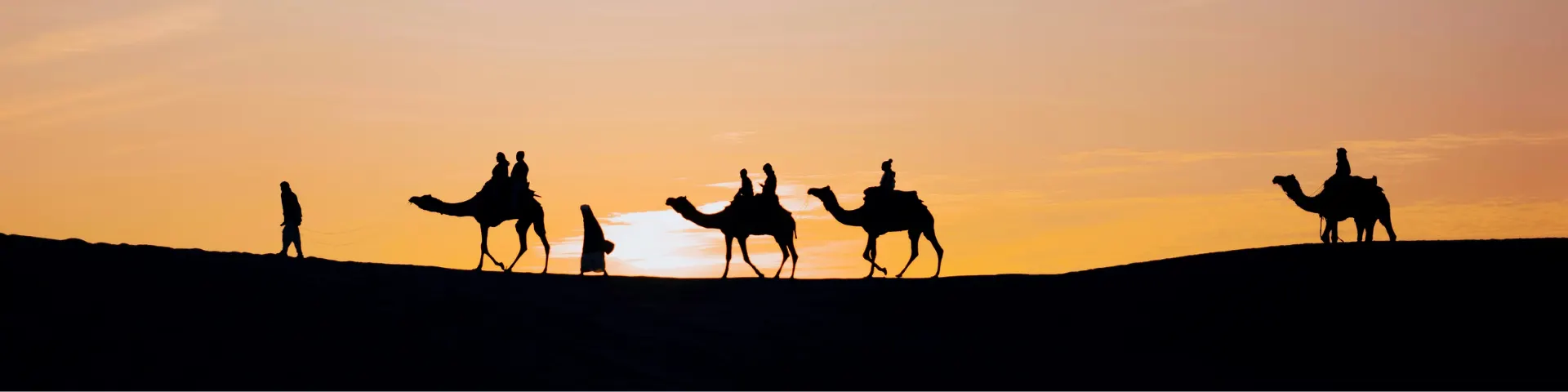
In short
Jaisalmer is the only city in India where a medieval fort is still a functioning town. This guide covers what that actually means for a first trip: the shape of the visit, the desert camp question answered honestly, and where to stay at each tier.
At a glance
- Core season
- October – February
- Strong first-time window
- October – November
- Peak
- December – mid-January
- Typical stay
- Three nights gives the city and desert enough room
When to go
Peak winter conditions are excellent but expensive, with properties filling early.
The strong winter window continues, with the Desert Festival adding a major February event.
The city remains comfortable, although desert heat begins building through the month.
Temperatures rise sharply and the article treats summer from April onward as a poor fit.
Most experienced travellers avoid Jaisalmer from May through September.
Extreme desert heat keeps this outside the recommended travel window.
Extreme desert heat keeps this outside the recommended travel window.
Extreme desert heat keeps this outside the recommended travel window.
Premium properties begin reopening around September, but this is still before the core season.
The core season begins; October is a strong shoulder month before the December rush.
The article consistently favours November for first-time visitors with flexibility.
Peak season brings excellent conditions, high rates and heavy demand.
January: Best time — Peak winter conditions are excellent but expensive, with properties filling early.
February: Best time — The strong winter window continues, with the Desert Festival adding a major February event.
March: Reliable — The city remains comfortable, although desert heat begins building through the month.
April: Off-season — Temperatures rise sharply and the article treats summer from April onward as a poor fit.
May: Off-season — Most experienced travellers avoid Jaisalmer from May through September.
June: Off-season — Extreme desert heat keeps this outside the recommended travel window.
July: Off-season — Extreme desert heat keeps this outside the recommended travel window.
August: Off-season — Extreme desert heat keeps this outside the recommended travel window.
September: Shoulder — Premium properties begin reopening around September, but this is still before the core season.
October: Best time — The core season begins; October is a strong shoulder month before the December rush.
November: Best time — The article consistently favours November for first-time visitors with flexibility.
December: Best time — Peak season brings excellent conditions, high rates and heavy demand.
Jaisalmer is the only city in India where a medieval fort is not a monument. It is a town. Roughly 3,000 people live inside its walls, in houses that have been occupied continuously since the 12th century. There are temples, guest houses, shops selling fabric and silver, a post office, children running between the lanes. Jain merchants built their havelis here in the 15th and 16th centuries and left ceilings of such concentrated carved detail that you can spend an hour in a single room and still not have seen everything. The fort is a UNESCO World Heritage Site, and unlike most UNESCO sites in India, it is not empty.
This matters more than it sounds. Most travellers arrive in Jaisalmer expecting a desert city with a fort to visit. What they find, if the trip is structured well, is something closer to the opposite: a fort that is also a city, surrounded by a desert that operates at its own register entirely. The two experiences, the medieval city and the Thar Desert, are genuinely different from each other, and a good Jaisalmer trip holds both rather than defaulting to one.
This guide covers the shape of a Jaisalmer visit: how long it takes to do it properly, what the fort actually requires, the desert camp question answered without the marketing language, and where to stay depending on what kind of trip you want to come home from.
How long Jaisalmer actually takes
Two nights is the honest minimum. One night means the fort is a rushed morning and the desert is a sunset you watched from the back of a jeep before dinner. Two nights gives you a proper day in the city, time inside the fort without watching a clock, and either a sunset on the dunes or a desert camp overnight without compressing everything.
Three nights is where the trip opens up. A day for the fort, the havelis, and Gadisar Lake in the evening. A day for the desert, done at the right pace. A morning left over for Bada Bagh, the royal cenotaphs north of the city, where the light in the early hours is worth the early start. Three nights is also the right length if you want a Manganiyar music evening, which is one of those experiences that works properly only when you are not rushing to a 6am departure the next day.
The question of whether to visit Jaisalmer as a standalone trip or as part of a wider Rajasthan circuit depends on where you are flying in from and how much of Rajasthan you want to see.
As a standalone trip, Jaisalmer works well for travellers flying in from Delhi or Mumbai for a focused desert visit. The Jaisalmer Airport now has direct connections to both cities, which removes the long drive from Jodhpur that used to be the only option. Two to three nights, fly in, fly out. The city and the desert in a concentrated form.
As part of a Rajasthan circuit, Jaisalmer sits naturally between Jodhpur and the journey back east. The drive from Jodhpur is around five hours through the Thar landscape and is itself worth the time if you are not in a hurry. This is the shape most premium Rajasthan itineraries take: Jaipur, then west through the Shekhawati belt, Bikaner, Jodhpur, Jaisalmer, and back. Each city doing a different job on the same route. If this is the shape you are considering, our Rajasthan: Forts, Palaces, Havelis journey → https://www.farboundtravels.com/journeys/rajasthan-forts-palaces-havelis-signature and Capitals & Caravans of Maharajas → https://www.farboundtravels.com/journeys/capitals-caravans-of-maharajas-signature are the natural starting points for the broader circuit conversation.
What the fort actually is, and why it changes the visit
Jaisalmer Fort was built in 1156 by Rawal Jaisal, a Bhati Rajput ruler who chose the Trikuta Hill, a 76-metre sandstone outcrop rising from the desert floor, for reasons that are immediately obvious when you see it: it is the only elevated ground for miles in any direction, and the sandstone it is made from is the same colour as everything around it. From a distance, the fort disappears into the landscape. Up close, it is enormous.
What makes it different from every other Rajput fort in Rajasthan is that it was never abandoned. Chittor was sacked and left. Amber was superseded by Jaipur and gradually emptied. Jaisalmer Fort remained a functioning town because Jaisalmer itself remained relevant as a trading post on the camel caravan routes between India and Central Asia, right up until Partition in 1947 rerouted the trade and made the desert city suddenly peripheral. By then, the habit of living inside the fort was eight centuries old and simply continued.
The result is a place that requires a different kind of attention than most Indian heritage sites. You are not moving through an empty palace reading plaques. You are walking through someone's neighbourhood. The Jain temples inside the fort, built between the 12th and 16th centuries and still in active use, have carved marble interiors of a quality that rivals anything in Rajasthan. The seven interconnected temples are dedicated to different Jain tirthankaras, and the stone-cutting on the ceilings is the kind of work that takes years to look at properly.
A good fort visit at Jaisalmer takes three to four hours with a specialist guide who can read the architectural history, the merchant community that funded the temples, and the way the fort's layout reflects 800 years of gradual accumulation rather than a single planned design. Done at that pace, with that context, the fort becomes the most layered experience of any Rajasthan city. Done as a two-hour walk-and-photograph visit, it reads as a pretty old town.
The havelis outside the fort walls, particularly Patwon ki Haveli and Nathmal ki Haveli, are worth a dedicated morning separately from the fort itself. The Patwon complex is five mansions built by a single family of Jain traders between 1805 and 1860, and the painted interiors are in a different register from the carved stone of the fort temples: colour, pattern, and merchant-world imagery that tells a specific story about what Jaisalmer was doing economically in the 19th century.
The desert camp question, answered honestly
The desert camp is the other half of a Jaisalmer trip, and it is the half where the gap between the marketing and the reality is largest.
The standard version is a shared tented camp at Sam Sand Dunes, 42 kilometres west of Jaisalmer. The dunes at Sam are genuinely beautiful, a long ridge of wind-sculpted sand that catches the last light in a way that is difficult to photograph accurately because it always looks better than the picture. The standard camps that have grown up around the dunes are a different matter. Generator noise from neighbouring camps, camel rides on a fixed circuit with a queue, folk music performances that run on a schedule for twelve groups simultaneously, and tents whose finish would not pass for a four-star hotel in any city. Travellers who have had a good Jaisalmer trip do not usually describe the Sam camp as the highlight.
The premium version is structured differently, and the differences are specific enough to be worth naming.
SUJÁN The Serai is a Relais & Châteaux property on a 100-acre private estate of desert scrubland, with 21 canvas suites, each raised on a sandstone plinth with its own terrace and sitting room. The Manganiyar musicians who play here in the evenings are performing for a single group of guests rather than a shared audience. The desert landscape around the camp is private and quiet in a way that Sam Dunes is not. The trade-off is distance: the Serai is roughly 50 kilometres from Jaisalmer Fort, which makes city sightseeing a day-trip rather than a morning walk. For a traveller whose priority is the desert experience above the city one, this is the right call. For a traveller who wants to be close to the fort and the havelis, it adds significant transfer time to every city day. The Serai also closes between June and August.
Suryagarh is the alternative for travellers who want strong hotel infrastructure with desert access. It sits 15 kilometres from the fort on the Sam road, architecturally styled to reference the Jaisalmer sandstone tradition, with 62 rooms, a proper spa, and direct access to desert experiences without the full remoteness of the Serai. It consistently receives strong reviews for service and food, and it functions as a city-and-desert base rather than a pure desert immersion. This is the more practical choice for a circuit traveller who has two nights in Jaisalmer and wants both the fort and the dunes without long transfers.
The fort stay is a third option worth knowing about. Several heritage properties operate inside or immediately below the fort walls, and for a certain kind of traveller, waking up inside an 850-year-old functioning city is the experience that no desert camp can replicate. The finish is generally more modest than Suryagarh or the Serai, and the narrow lanes mean luggage and transfers require planning. Worth raising in the planning conversation for travellers who are specifically drawn to the fort itself rather than the desert landscape.
The honest test for any desert camp: if the listing doesn't name the property, the acreage, and whether the evening entertainment is private or shared, assume the standard version.
What else Jaisalmer is doing
Jaisalmer is often treated as a two-experience city: fort and dunes. The traveller who stays three nights finds it is doing considerably more than that.
Gadisar Lake is a medieval reservoir built in the 14th century and still surrounded by carved temples, shrines, and ghats on all sides. In the early morning, before the tourist boats begin, the water reflects the golden sandstone of the structures around it and the whole place is very quiet. It is a fifteen-minute walk from the old city and is one of those visits that works best as an addition to a morning rather than a destination in its own right. Go at 6:30am. Stay for forty minutes.
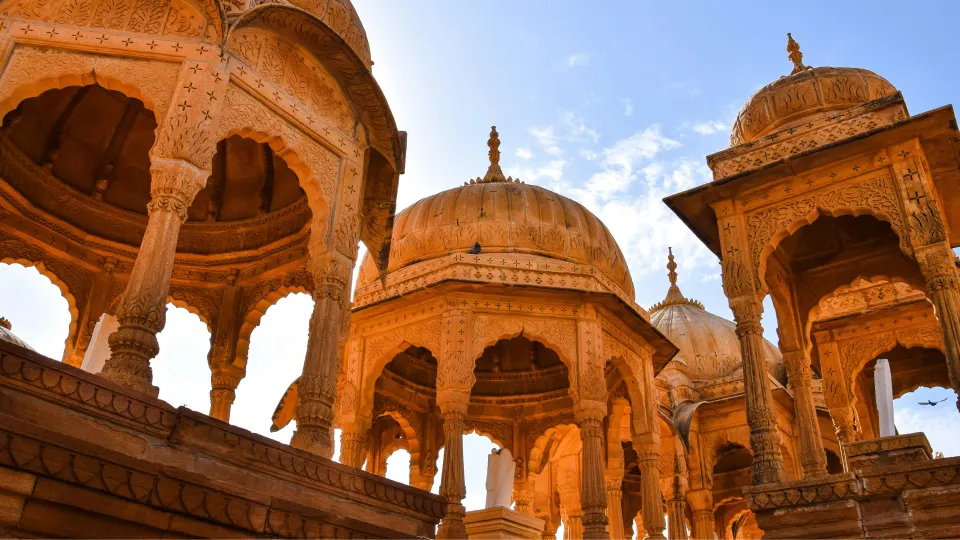
Bada Bagh is the complex of royal cenotaphs north of the city, built for successive rulers of Jaisalmer from the 15th century onward. The sandstone chhatris, domed pavilions on carved columns, are spread across a low hill and photograph well in any light, but the early morning is when the stonework is at its warmest and the site has not yet filled. What Bada Bagh does well is give Jaisalmer a temporal context: you are looking at the same sandstone, the same carving tradition, and the same royal lineage that built the fort, extended over 500 years.
The Manganiyar musicians are worth understanding before you encounter them. The Manganiyars are a Muslim community of hereditary musicians from the Thar Desert, whose repertoire spans Sufi devotional music, Rajasthani folk songs, and a body of compositions that have been passed down within specific families for generations. They performed for the Rajput courts and have continued performing for whoever is listening since. An evening with a Manganiyar group at a private setting, rather than a scheduled performance for a shared camp audience, is a different experience. It is worth asking specifically about in the planning conversation.
Kuldhara is a village that was abandoned overnight in 1825 by its entire population of Paliwal Brahmins, for reasons that local history records variously as a dispute with the regional governor, a forced marriage demand, or simple flight from taxation. Whatever the cause, the village was left intact and never reoccupied. It is now a preserved ghost town 18 kilometres from Jaisalmer, with the original street plan, house structures, and temple still standing. It takes an hour to walk and it reads, with the right guide, as one of the more unsettling and interesting stops in the region.
When to go
Jaisalmer is a winter destination. The operating window for most premium properties, including the Serai, runs roughly September to May, with the core season from October to February.
October to November is the shoulder before peak, and consistently the best window for first-time visitors. The heat of summer has gone, the desert is at its most photogenic in the clear post-monsoon light, the heritage properties are at their most attentive before the December rush, and rates sit below the December-January high. Most experienced operators will quietly suggest November over December to travellers who have flexibility.
December to mid-January is peak season. The Desert Festival, a three-day cultural event held annually in February near the Sam Dunes, draws significant crowds and is worth attending specifically for the Manganiyar and Langas musicians who perform across the programme. Outside the festival, December and January are excellent but expensive, with properties filling early and rates at their highest.
February to March is another strong window, with the heat beginning to build through March on the desert floor. Still very comfortable for most of the window and considerably less crowded than December.
The summer months from April onward bring temperatures that regularly exceed 40 degrees Celsius on the desert floor. The Serai closes entirely. Most experienced travellers do not visit Jaisalmer between May and September, and the advice to avoid this window is straightforward.
Planning a Jaisalmer trip
Jaisalmer rewards the traveller who has thought about it before arriving. Not because it is difficult, but because the difference between the fort walk that takes two hours and tells you relatively little, and the fort walk that takes four hours with a guide who has spent years inside those lanes, is not visible from the outside of a booking. The same is true of the desert camp, the Manganiyar evening, and the haveli visits. The experiences are available to everyone. The quality of the experience depends on the people and the preparation behind it.
A first visit to Jaisalmer, done well, tends to produce a specific reaction: the traveller comes back quieter than they left. The desert does something to pace. The city, which has been operating at the same rhythm for eight centuries with very little interest in what the rest of the world is doing, does something to perspective. It is one of those places that works on you without announcing that it is working on you, which is harder to engineer than it sounds.
For travellers considering Jaisalmer as part of a wider Rajasthan circuit, our Rajasthan: Forts, Palaces, Havelis → https://www.farboundtravels.com/journeys/rajasthan-forts-palaces-havelis-signature and Capitals & Caravans of Maharajas → https://www.farboundtravels.com/journeys/capitals-caravans-of-maharajas-signature journeys cover the broader circuit at both Classic and Signature tier. For a Jaisalmer-specific conversation, or to build something from scratch around this city, the Plan Your Trip → https://www.farboundtravels.com/plan-your-trip page is where to start.
Good to know
Sources
- Farbound Travels — title, excerpt and guide content supplied in this row
Written by Mahim Tiwari.
Published May 2026 · Last updated September 2026
Keep reading
Maharajas' Express vs Palace on Wheels vs a Private Journey: Which Is Right for You?
India's two best-known luxury trains and a private journey solve different problems. Compare ro...
Luxury Golden Triangle India: What Is Actually Worth Upgrading?
A high-end Golden Triangle trip is not improved by upgrading every line item. Here is where bet...