In short
Plan your Kanha and Pench tiger safari in 2026: zones, booking strategy, best season to go, and what Jungle Book country actually looks like on the ground.
At a glance
- Park closure
- July – September
- Peak season
- November – February
- Shoulder
- October and March
- Hot-season sightings
- April – June can be excellent for tigers despite 35–40°C daytime heat
When to go
Cool, dry safari conditions and strong visibility make January part of the peak season.
The cool peak season continues, with strong wildlife activity around permanent water.
March is warmer but remains reliable for tiger activity with fewer crowds.
Heat rises sharply, but drying water sources can improve tiger sighting odds.
Hot conditions continue while wildlife concentrates around remaining waterholes.
The hot season can still produce excellent tiger sightings for heat-tolerant travellers.
Both parks are closed during the monsoon.
Both parks are closed during the monsoon.
Both parks are closed during the monsoon.
Post-monsoon greening brings lush landscapes and slightly more dispersed wildlife.
Cooler, dry conditions begin the main peak safari season.
Peak-season weather and good visibility continue through December.
January: Best time — Cool, dry safari conditions and strong visibility make January part of the peak season.
February: Best time — The cool peak season continues, with strong wildlife activity around permanent water.
March: Shoulder — March is warmer but remains reliable for tiger activity with fewer crowds.
April: Reliable — Heat rises sharply, but drying water sources can improve tiger sighting odds.
May: Reliable — Hot conditions continue while wildlife concentrates around remaining waterholes.
June: Reliable — The hot season can still produce excellent tiger sightings for heat-tolerant travellers.
July: Off-season — Both parks are closed during the monsoon.
August: Off-season — Both parks are closed during the monsoon.
September: Off-season — Both parks are closed during the monsoon.
October: Shoulder — Post-monsoon greening brings lush landscapes and slightly more dispersed wildlife.
November: Best time — Cooler, dry conditions begin the main peak safari season.
December: Best time — Peak-season weather and good visibility continue through December.
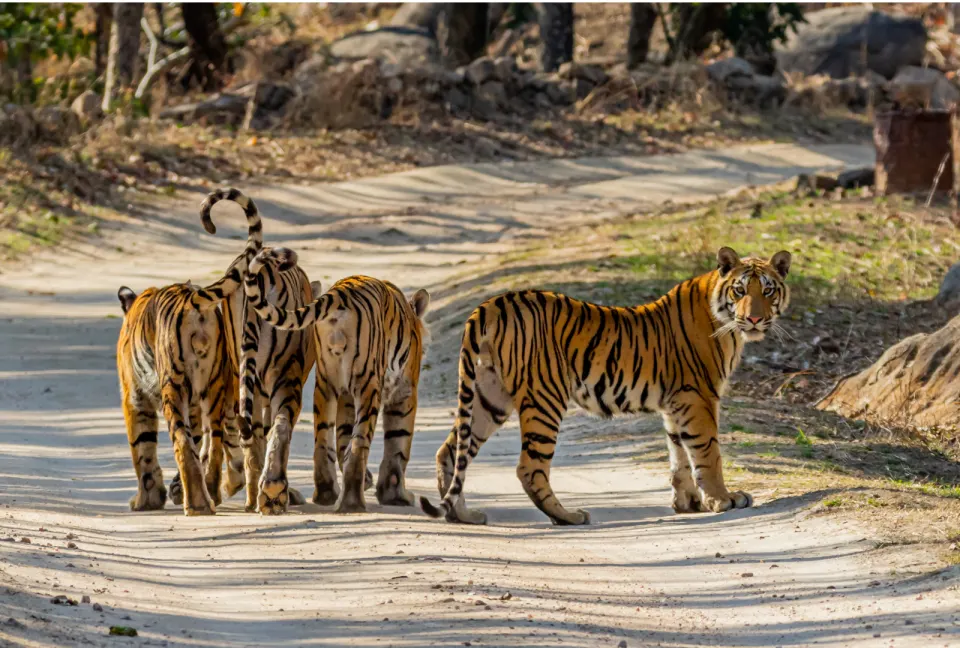
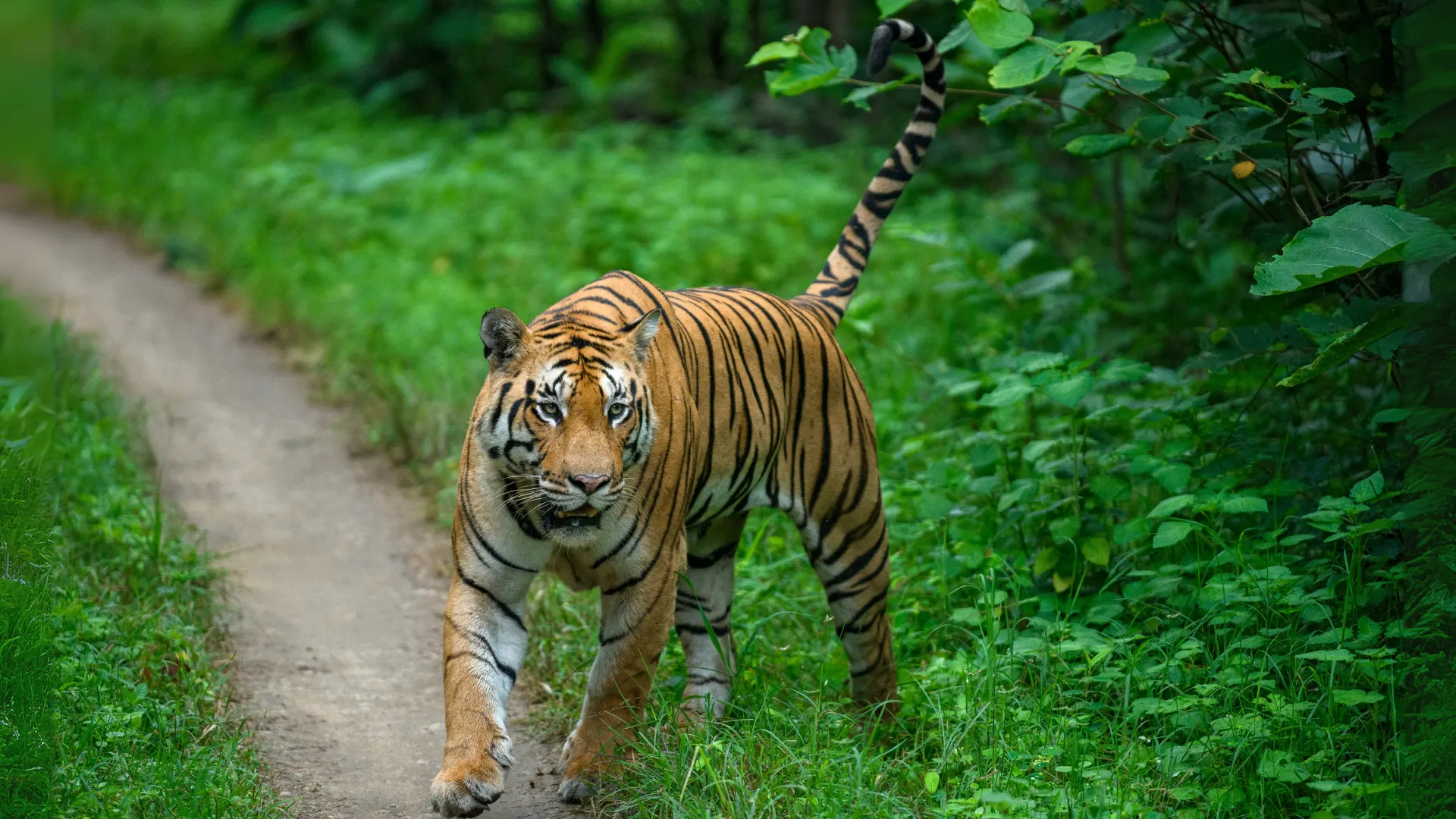
When you're planning a Kanha and Pench tiger safari, two facts set these reserves apart from the rest of India's wildlife circuit. First: Kanha and Pench are the parks where Rudyard Kipling set The Jungle Book, separated by 140 kilometres of forest corridors in Madhya Pradesh. Second: they're among India's most reliable destinations for actually seeing tigers in the wild — not glimpsing a distant shape, but watching a tiger cross an open meadow at dawn.
The difference between the two is worth understanding before you book. Kanha is the larger reserve with greater wildlife diversity and a barasingha conservation story most visitors don't know. Pench is smaller, its forest more open, its tiger sighting odds per safari slightly higher. Most visitors don't choose between them — they combine both. That's the smarter approach.
Kanha National Park: India's First Tiger Success Story
Kanha National Park covers 940 square kilometres of protected core area, with buffer zones extending to 2,051 sq km. Established in 1955, it was one of India's first tiger reserves and remains one of its conservation cornerstones.
The landscape is dominated by sal and bamboo forests interspersed with open meadows — locally called maidans. These meadows are crucial to tiger ecology. They're where tigers hunt at dawn and dusk, and where you're most likely to see them on a Kanha and Pench tiger safari. The terrain is rolling rather than mountainous, which means jeep safaris can cover significant distance each morning and afternoon.
The reserve holds approximately 100+ tigers in the core area, alongside a robust population of barasingha (swamp deer), leopard, wild dog (dhole), and sloth bear.
The Barasingha Story: Why Kanha Matters Beyond Tigers
Here's something most tiger safari guides gloss over: Kanha is home to one of India's most significant wildlife conservation successes, and it has nothing to do with tigers.
The barasingha, or swamp deer, was hunted to near extinction across India by the early 1970s. In Kanha, the population had crashed to under 70 animals. The park's management made a specific decision: focus intensive protection on this single species — creating restricted zones, controlling poaching, managing habitat for barasingha recovery.
Today, Kanha's barasingha population stands at over 800 individuals. This is the difference between a species existing only in a few reserves and a species with a viable, growing population. Every time you see a barasingha during your safari — and you will, often in groups — you're looking at decades of committed conservation effort.
For wildlife enthusiasts, this context transforms a tiger safari into something more: a chance to witness what protection actually achieves.
Kanha Zones and Booking Strategy
Kanha operates through six tourism zones: Kanha, Kisli, Mukki, Sarhi, Khatiya, and Sijhora. Zone allocation is government-controlled, and the most popular zones book months ahead during peak season.
The Kanha and Kisli zones see the highest tiger activity. Kisli is known for open meadows and good visibility; Kanha main zone has denser forest but more reliable permanent water sources. If you're booking for November through February, secure your zone allocation 6-8 weeks ahead.
Morning safaris are significantly better than afternoon safaris for tiger sightings. Tigers hunt at dawn and are most active in early light. If you can only do one safari per day, choose the morning slot.
Pench National Park: Smaller, Sharper, More Open
Pench National Park is smaller — 292 square kilometres of core area, 758 sq km total — and straddles the Madhya Pradesh-Maharashtra border. The terrain differs markedly from Kanha: mixed teak, tendu, and bamboo forest with a more open canopy across much of the reserve.
The Pench River flows through the park, shaping tiger movement and sighting opportunities. Pench holds an estimated 50-60 tigers in the core reserve. Alongside the tigers are some of India's largest concentrations of chital (spotted deer) — the herds here exceed what you'll see at most other reserves. Leopard populations are healthy, and wild dog sightings are reliable if your guide knows the routes.
Tiger Sighting Reality: Kanha vs. Pench
Both parks have good tiger populations. The difference is in the math.
Kanha's larger area means tigers are more dispersed. On a given safari, you might cover 20-30 km, spot multiple tiger signs (pug marks, scratch marks, kills), and not see the animal itself. Sightings happen frequently — but they're never guaranteed.
Pench's smaller size concentrates both tigers and safari routes. Fewer roads covering a smaller area means the odds tilt slightly in your favour. Add the more open habitat, and Pench has a deserved reputation for more reliable sightings per safari.
If you can visit only one reserve: choose Kanha for overall wildlife density, landscape variety, and the barasingha story. Choose Pench if tiger sighting probability is your single priority. If you can do both — and you should — Kanha gives you the full Madhya Pradesh experience, Pench delivers on the numbers.
The Jungle Book Geography: Seoni and Shere Khan's Territory
Seoni, a small town on Pench's edge, is where Kipling set The Jungle Book. The town, the forests, and the Pench landscape loosely map to Kipling's geography: the wolf pack's den, Shere Khan's hunting territories, Baloo's forest, the ancient ruins. Park authorities and local guides have leaned into this connection, and specific sites near Seoni correspond to locations in the narrative.
That said, the reason to visit these parks is the wildlife, not the literary tourism. The Jungle Book connection is a worthwhile addition, not the primary draw.
Safari System: How Booking Works
Both parks operate through the Madhya Pradesh Forest Department portal (mpforest.gov.in). Safari slots are allocated through an online booking system, and demand exceeds availability during peak season.
Each government jeep accommodates a maximum of six passengers, with a driver and assigned naturalist. Morning safaris run roughly 4 hours; afternoon safaris 3-4 hours depending on zone.
Costs are approximately Rs. 4,000-8,000 per jeep depending on reserve, zone, and season — covering park entry, vehicle, and guide fees. Advance booking is essential: 6-8 weeks ahead for November through February, 4-6 weeks for March through May, 2-3 weeks for shoulder season.
When to Visit: Season, Weather, and Tiger Activity
Both parks close during monsoon (July through September). The remaining months split clearly:
Peak season (November through February): Cool mornings (5-15°C at dawn), dry conditions, excellent visibility. Tiger activity is high as animals concentrate around permanent water sources. Most competitive booking period.
Shoulder season (October and March): Post-monsoon greening in October makes for lush landscapes with slightly more dispersed wildlife. March is warm but tiger activity remains strong. Less crowded, still reliable.
Hot season (April through June): Daytime temperatures climb to 35-40°C, but this is paradoxically among the best seasons for tiger sightings. As water sources dry up, animals concentrate around remaining waterholes. Early mornings and late afternoons see intense wildlife activity. If you can tolerate the heat, the sighting odds are excellent.
For a first visit: choose November through February. For experienced safari-goers who prioritise sighting odds over comfort: April through June.
What to Bring
- Binoculars — Essential. An 8x42 or 10x42 pair makes the difference between spotting a distant tiger and missing it entirely.
- Camera gear — For wildlife photography: a telephoto lens (at least 300mm), a sturdy monopod, and extra batteries. Guides work well with photographers who stay patient.
- Layered clothing — Early mornings are cold (10-15°C in winter); bring a warm layer and windproof jacket.
- Sun protection — High SPF sunscreen, hat, sunglasses — the open jeeps offer no shade.
- Insect repellent — DEET-based; consider prophylaxis based on current guidance.
- Field guide — A regional guide to Indian birds and mammals helps you identify everything beyond tigers. There is far more to see.
The Odds of Seeing a Tiger
Let's be direct: tiger sightings are not guaranteed.
Guides and lodges will sometimes imply they are. They're not. A sighting requires the tiger to be in your zone, active during your safari window, and willing to cross a road or meadow where you can see it.
Reasonably skilled guides under good conditions achieve tiger sightings on 50-70% of safaris during peak season. Across 4 safaris (2 days at each park), the statistical expectation is at least one sighting. You might see three. You might see none. This uncertainty is precisely why sightings are meaningful.
The Real Draw: It's Not Just Tigers
A morning safari at Kanha will show you barasingha, sambhar, chital in hundreds, wild boar, rhesus macaques, langurs, monitor lizards, peacocks, multiple eagle species, and — if your guide knows the territory — sloth bear or wild dog packs.
The landscape is beautiful in a non-photogenic way. These are working forests, not stage-managed reserves. The ecology is complex and functioning. You're watching an actual ecosystem that tigers happen to be part of.
Practical Information for 2026
Booking portal: Madhya Pradesh Forest Department (mpforest.gov.in). Third-party operators offer alternative routes and accommodation packages.
Entry requirements: Indian citizens need photo ID. Foreign nationals should carry passport and visa documentation.
Accommodation: Government lodges are affordable and basic. Private resorts — Forsyth Lodge at Kanha, Kings Lodge and Pench Tree Lodge at Pench — offer significantly more comfort and English-speaking naturalists. Book accommodation alongside safari slots; good lodges fill 2-3 months ahead during peak season.
Guides: Government guides are knowledgeable, though English proficiency varies. Private operators provide English-speaking expert naturalists at higher cost. The quality of your guide shapes the experience more than any other factor.
Cost reference: A well-planned 5-7 day Kanha-Pench circuit with private jeep safaris, expert naturalist, and quality lodge accommodation runs approximately $450-700 per person per day or higher in peak season. Shared government jeeps and basic lodges cost significantly less; the tradeoff is in guide quality and the depth of what you learn during the safaris.
Planning This Circuit With Farbound
When we plan this circuit, we start with who is coming and why. A first-time visitor to the Indian forest and an experienced safari traveller moving on from Ranthambore need different things from the same landscape. A family with young children and a photographer working a telephoto lens have different demands on how a day is structured. The itinerary follows from those specifics.
The naturalists we work with at Kanha and Pench have spent years in these forests. They know which zones are better for that times of year, how to read animal behaviour at a distance, and how to structure a morning so the best conditions and the best sightlines coincide. That level of knowledge comes from time in the field, not from a guiding certificate.
Our guests come to watch wildlife, not to manage an itinerary. Every detail is handled before they arrive. On select itineraries, this includes meals served inside the park at the end of a morning safari, before the forest has had time to quiet down.
If you would like us to plan this for you, tell us what you're looking for.
Why These Parks, Why Now
Central India's tiger reserves recovered from dangerously depleted populations in the 1970s. Kanha and Pench are part of that recovery. The barasingha restoration at Kanha, the tiger population rebound at both reserves, and the expanding wildlife corridors connecting them are evidence that protection works.
A safari here is not vacation theater. It is a chance to see a functional ecosystem where megafauna persist because humans chose to protect them. That remains increasingly rare.
Visit during cool months for comfort and company. Visit during hot months for tiger sightings and solitude. Visit for barasingha if conservation is the draw. Visit for Shere Khan's territory if Kipling's mythology is what brought you here. Either reason holds.
View our India wildlife trips or tell us what you're looking for and we'll build it around your schedule and priorities.
Last updated: May 2026
Good to know
Sources
- Farbound Travels — title, excerpt and guide content supplied in this row
Written by Mahim Tiwari.
Published May 2026 · Last updated September 2026
Keep reading
Ladakh Travel Guide: Altitude, Seasons and How to Plan the Route
Plan a Ladakh journey through Leh, Nubra and Pangong with clear guidance on acclimatisation, se...
Orchha, Khajuraho and Gwalior: A Central India Heritage Route
A practical guide to Gwalior, Orchha and Khajuraho, including what each destination adds, how m...