In short
Kashmir travel guide for summer: the Great Lakes Trek, Mughal gardens, Gulmarg, and the seasonal reality. What to actually do, when to go, and how to plan properly.
At a glance
- Main summer window
- June – August
- Summer temperatures
- About 15–30°C
- Great Lakes trek
- Mid-July – early September
- Advance planning
- Book roughly 3–4 months ahead for summer travel
When to go
This sits outside the article’s main summer operating window, with much high-altitude travel inaccessible.
This sits outside the main summer operating window for the route described.
The article does not treat March as part of the normal summer operating season.
Most of the high-altitude summer route is still outside its stated operating window.
The article’s main travel window has not yet begun; summer access starts in June.
The main summer season opens, with clear skies, full lakes and high passes accessible.
Peak summer access is strong, but mountain weather and brief heavy rain require buffer time.
The main summer season continues, with peak demand and the same need for weather buffers.
The Great Lakes trek can run into early September, but the article says conditions destabilise by mid-month.
This falls outside the article’s stated summer operating window.
This falls outside the article’s stated summer operating window.
This falls outside the article’s stated summer operating window.
January: Off-season — This sits outside the article’s main summer operating window, with much high-altitude travel inaccessible.
February: Off-season — This sits outside the main summer operating window for the route described.
March: Off-season — The article does not treat March as part of the normal summer operating season.
April: Off-season — Most of the high-altitude summer route is still outside its stated operating window.
May: Off-season — The article’s main travel window has not yet begun; summer access starts in June.
June: Best time — The main summer season opens, with clear skies, full lakes and high passes accessible.
July: Best time — Peak summer access is strong, but mountain weather and brief heavy rain require buffer time.
August: Best time — The main summer season continues, with peak demand and the same need for weather buffers.
September: Shoulder — The Great Lakes trek can run into early September, but the article says conditions destabilise by mid-month.
October: Off-season — This falls outside the article’s stated summer operating window.
November: Off-season — This falls outside the article’s stated summer operating window.
December: Off-season — This falls outside the article’s stated summer operating window.
Kashmir is not one destination. It is a region that offers radically different experiences depending on what you want to do, when you arrive, and how you're willing to structure your time.
Most travel writing treats Kashmir as a single aesthetic-gardens, lakes, soft light, romance. It is those things. But it is also one of India's premier adventure tourism destinations. The Great Kashmir Lakes Trek ranks among the finest high-altitude treks in the country. Gulmarg is a ski resort in winter and an alpine meadow destination in summer. Srinagar's Mughal gardens are architectural statements about power and water management, not Instagram backdrops. And the entire region operates on a narrow seasonal window that determines what is actually possible.
This guide is for travellers and advisors planning Kashmir properly. Which means understanding the seasonality first, then the actual options.
Kashmir's Operating Season: Why Summer Matters and What It Costs
Kashmir has four seasons. Three of them are beautiful. One of them is where travel actually happens.
The summer window in Kashmir runs from June through August. During these months, temperatures range between 15°C and 30°C. The skies are clear. The lakes are full. The high passes are open. Everything that makes Kashmir a destination is accessible.
This is also the peak season, which means everything is booked. Hotels, guides, permits, accommodation on houseboats or in heritage properties-all require advance booking. If you are planning a Kashmir trip, plan it at least 3 to 4 months ahead, and expect to pay peak rates.
July and August carry an additional operational reality: mountain weather is unpredictable. The monsoon brings brief, intense rainfall that can temporarily close high mountain passes-particularly the roads to Sonamarg and the higher trekking trails. Landslides are possible. If your itinerary depends on reaching a specific place on a specific day, you need buffer days built in. This is not a problem. It is a fact of travel in the Himalayas. Plan accordingly.
Acclimatization is non-negotiable. If you are arriving in Srinagar and planning to trek at altitude-say, the Kashmir Great Lakes Trek, which reaches 13,750 feet at Gadsar Pass-spend at least one full day in Srinagar (3,600 feet) before moving higher. Your body needs time to adjust to the thinner air. Skipping this step is how travellers end up with altitude sickness that ruins their trips.
The seasonal constraint is actually an operational advantage. Because so much of Kashmir is only accessible during these three months, the experience is more controlled. The landscape, the weather patterns, the capacity of trails and guides-all of it is predictable within the summer window. Outside of summer, much of Kashmir is inaccessible. So if you are going, go during summer. Build the buffer time. Book early. And understand what that window actually opens up.
Srinagar: The Mughal Gardens and Dal Lake
Srinagar is the capital and the logical base for a Kashmir trip. It sits at 3,600 feet, which makes it a good acclimatization point before heading higher. The city is built around Dal Lake, a sprawling body of water that has shaped settlement, economy, and culture for centuries.
There are two reasons to spend time in Srinagar: the Mughal gardens and understanding the spatial relationship between the water, the city, and the surrounding hills.
The Gardens: Shalimar and Nishat
Shalimar Bagh was built in 1619 by Emperor Jahangir for his wife Nur Jahan. The name translates roughly to "Abode of Love." The garden is structured in three terraces, each serving a different purpose: the lower terrace for public gatherings, the middle for the royal family, and the upper for the emperor and his court. The water flow, the pavilions, the arrangement of walkways-all of it reflects the Persian chahar bagh concept, four flowing rivers of paradise, adapted to the Himalayan valley.
What matters operationally: Shalimar is dense, best visited early in the morning before crowds arrive. Allow 2 to 3 hours. The terraces require walking up and down, so wear comfortable shoes. The views from the upper terraces back toward Dal Lake and the city are the visual payoff.
Nishat Bagh, built in 1633 by Asif Khan (brother of Nur Jahan), is larger. It has 12 terraces instead of three. It is also on the eastern shore of Dal Lake, which means the water is integrated into the garden's design-the lake is not just a backdrop, it is a spatial element the garden relates to. Nishat means "Garden of Joy" in Urdu. The garden is less crowded than Shalimar, particularly if you visit in the late afternoon.
Both gardens are best visited separately, not on the same day. If you have time for only one, Shalimar has more historical weight. If you have time for both, Nishat offers a different spatial experience. Both are active Mughal gardens-they are maintained, they are lived in by gardeners and staff. They are not preserved as museums.
Spend your time sitting in these gardens. Walk slowly. Understand how the water moves through the terraces, how the plantings are organized, how the views are composed. The gardens are not beautiful because they were designed to be beautiful. They are beautiful because they were designed to solve a problem-how to live and rule in a mountain valley with abundant water.
Dal Lake and the Shikara Experience
Dal Lake is 8 kilometers long and 6 kilometers wide. It is not particularly deep-average depth is around 6 meters-and its ecology is carefully managed. The lake is fed by springs and seasonal streams from the surrounding hills.
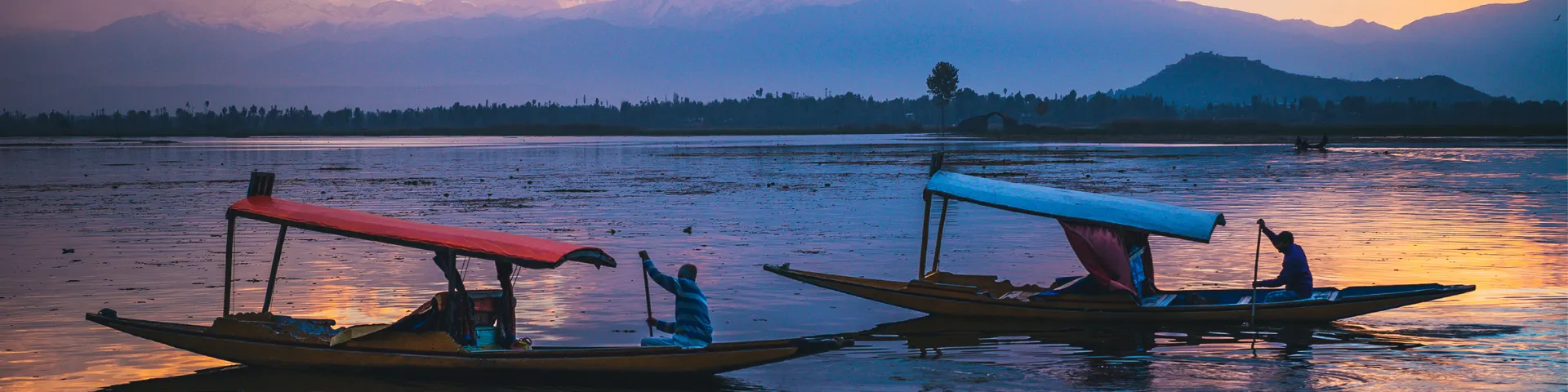
A shikara is a traditional wooden boat, flat-bottomed and shallow-drafted, designed to navigate the shallow waters. A shikara ride is on most travellers' Kashmir itineraries. Some travellers stay on houseboats moored on Dal Lake. Others experience the houseboats through meals or afternoon visits. From a premium travel standpoint, houseboats have operational constraints they are moored, they limit your ability to move through the city, and they trade some comfort for the experience of being on the water. This is worth understanding. It is not a problem with houseboats. It is simply a different trade-off than staying in a centrally located heritage hotel or international property.
A shikara ride should be taken in the early morning, when the light is soft and the water is still. The typical route includes the floating market-vendors selling flowers, vegetables, and local goods from small boats-and passes the smaller islands and their inhabitant communities. This is not tourism theater. This is how the lake actually functions. You see people going to work, children going to school, the daily life of the lake.
Allow 2 to 3 hours for a shikara ride. Book through your hotel or directly with boatmen at the ghat itself. Prices are fixed and negotiable. If you are prone to motion sickness or discomfort on water, know that shikara boats move slowly and sit very low to the water, which is generally stable.
Gulmarg: The Alpine Summer Destination
Gulmarg sits at 8,690 feet in the Pir Panjal range, about 45 kilometers from Srinagar by road (1.5 to 2 hours of driving, depending on traffic and weather). The name means "Meadow of Flowers." In winter, Gulmarg is India's primary ski destination. In summer, it transforms into a lush alpine meadow with clear views of surrounding peaks and a cool climate that is a genuine escape from the heat of the plains.
What to Do in Summer Gulmarg
The Gondola Ride is the primary attraction and the justification for the destination. The Gulmarg Gondola is the world's second-highest cable car. It climbs from the meadow (8,690 feet) to Apharwat Peak (around 13,600 feet) in two phases. The first phase takes you to Strawberry (11,000 feet); the second phase continues to the top. The ride takes about 30 minutes total. On a clear day, you can see the snow-capped peaks of the Himalayas, the Pir Panjal range, and on exceptionally clear days, Mount Harmukh and the high passes. This is worth doing. It is also crowded. Book early, arrive early, and go on a day with clear visibility. A day with clouds will give you views of nothing but cloud.
Hiking and Trekking from Gulmarg is substantial. There are easy walks through the meadows for families, and there are day treks through alpine terrain for experienced hikers. The Great Kashmir Lakes Trek begins nearby (typically from Sonamarg, not Gulmarg proper, but Gulmarg functions as a staging point). If you are in Gulmarg and interested in walking, your hotel or a local guide can arrange routes appropriate to your fitness level.
Horse Riding through the meadows is popular and generally available through hotels or local guides. Expect to pay around 500 to 1,000 INR for an hour-long ride.
The Climate is cool, even in summer. Temperatures in Gulmarg typically range from 10°C to 20°C during the day. In early summer (June and July), you may encounter snow on the higher meadows. This is not a problem. It is part of the landscape.
Allow 2 to 3 days in Gulmarg if it is part of a larger Kashmir itinerary. One day minimum for the gondola and local walks. Additional days if you want to hike or use it as a base for larger treks.
The Kashmir Great Lakes Trek: High-Altitude Adventure
The Kashmir Great Lakes Trek is one of the finest high-altitude treks in India. It is also one of the most operationally constrained, which is why understanding the parameters matters before committing.
Trek Fundamentals
The trek covers approximately 75 kilometers, passes through seven alpine lakes, crosses three high mountain passes, and takes 7 to 8 days to complete. The highest point is Gadsar Pass at 4,206 meters (13,750 feet). The trek begins at Shitkadi near Sonamarg and ends at Naranag. Along the way, you pass Vishansar Lake, Krishansar Lake, Gadsar Lake, and Satsar Lake, among others. Each lake is surrounded by high meadows and rocky terrain.
The trek is rated moderate to difficult. This is accurate. Most days involve 9 to 12 kilometers of walking, often at altitude. The passes involve sustained climbing. If you are not comfortable walking 5 to 7 hours a day on rocky, sometimes steep terrain, this trek is not for you. The altitude is real. Altitude sickness is possible, even for fit travellers.
Who should do this trek? Experienced hikers, people who have trekked at altitude before, people willing to train for 3 to 5 months in advance if they are not already fit. Beginners can do this trek, but they need to acknowledge the commitment and the preparation required.
The Seasonal Window
The trek is only accessible from mid-July to early September. Outside this window, the trail is covered in snow. The snow typically clears by late June, making the second half of July the realistic start date. By mid-September, the weather destabilizes and the trek is no longer conducted.
This means if you want to do the Kashmir Great Lakes Trek, you need to book and plan for summer. There is no other season. This is a constraint that should be respected, not worked around.
The Cultural Layer
The lakes are not simply geographic features. Vishansar is associated with Lord Vishnu. Gangabal and Nundkol are considered sacred and linked with the Ganges. Locals speak about these places with respect and spiritual significance. This adds a layer to the trek beyond the physical challenge and the scenery. You are moving through landscape that has meaning to people who live here.
Other Trek Options and Adventure Activities
If the Great Lakes Trek is beyond your fitness level or timeline, there are other options.
Tarsar Marsar Trek is shorter (4 to 5 days), lower altitude (highest point around 3,800 meters), and more accessible to intermediate trekkers. It passes through two alpine lakes set in forest and meadow terrain. Same seasonal window (July to September).
Pahalgam is a hill station south of Srinagar, cooler and less crowded than the main valley towns. It serves as a base for day hikes, horseback rides, and access to streams and waterfalls. Operationally simpler than trekking.
Sonamarg, meaning "Meadow of Gold," is a high-altitude meadow at 2,700 meters that serves as the staging point for the Great Lakes Trek. Even if you are not trekking, a day in Sonamarg offers alpine meadows, rivers, and a sense of the landscape the trek moves through.
Warwan Valley in autumn (September to October) is a trekking destination known for long trails through less-visited terrain. It is more remote and requires more planning than the main summer destinations.
All of these require advance booking, guides, and understanding of seasonal constraints. None of them are casual add-ons. They are part of a structured itinerary.
What to Know Before You Arrive
Transportation
The primary airport is Sheikh ul-Alam International Airport in Srinagar, served by flights from Delhi, Mumbai, and other major Indian cities. From the airport to Srinagar city is about 15 kilometers and typically takes 30 to 45 minutes by vehicle.
Driving within Kashmir uses public roads that, during summer, are generally well-maintained. In July and August, heavy rainfall can cause temporary closures or delays. Build buffer time into any itinerary that depends on road travel. Check weather forecasts and local reports before moving between destinations.
Accommodation
Srinagar has heritage hotels (converted old mansions and palaces), international hotel brands, and houseboats. For premium travel, the heritage properties offer better value and more character than generic 5-star hotels. They are centrally located and staffed by people with local knowledge.
Gulmarg has resort properties and smaller heritage stays. Most are accessed via the main road through town. There is no escaping the fact that Gulmarg is a hillstation with tourism infrastructure.
Pahalgam and Sonamarg have smaller properties, typically run by local families or adventure tourism companies.
Food
Kashmir's cuisine is distinctive and heavily influenced by its Muslim majority and Mughal history.Wazwan is the traditional multi-course meal, typically meat-based (lamb, goat, sometimes chicken), with slow-cooked gravies, rice, and bread. It is rich and requires time to eat properly.
Day-to-day food in Srinagar includes vegetarian options (paneer-based dishes, legumes, rice), fresh fish from the lakes, and roti/naan bread. Tourist restaurants cater to international palates. Local restaurants offer authentic Kashmiri food at lower cost.
In the higher destinations (Gulmarg, on treks), food is simpler: basic curries, rice, bread, limited fresh vegetables. If you have specific dietary requirements, communicate them in advance.
Permits and Regulations
As of 2026, there are no special permits required for foreign nationals to visit Kashmir. This may change. Check current government advisories before booking. For trekking, many organized treks include guide and permit arrangements. Confirm this before committing.
Timing and Pacing
A minimal Kashmir itinerary is 5 to 7 days: 2 to 3 days in Srinagar (gardens, lake, acclimatization), 1 day in Gulmarg, 1 day in Pahalgam. This allows you to see the main destinations without rushing.
A trek-inclusive itinerary is 10 to 14 days: 2 to 3 days for acclimatization and the main sights, 8 to 9 days for the trek itself, 1 to 2 days for recovery and travel.
Do not plan a trip where you arrive, head directly to high altitude, and start trekking the next day. Your body will not thank you. Acclimatization is not optional.
Why Kashmir, Actually
Kashmir works because it offers multiple complete experiences within a single region, all accessible during one seasonal window. You can spend time in Mughal gardens that are architectural and historical statements. You can experience high-altitude alpine trekking that compares to anywhere in the world. You can stay in a cool meadow at 8,700 feet while the rest of India swelters. You can travel through landscape that has shaped empire and culture for centuries.
It is not a place to visit without planning. The seasonal window is real. The altitude is real. The infrastructure is less developed than, say, Rajasthan. But if you understand those constraints and plan accordingly, Kashmir offers depth and adventure that most other Indian destinations do not.
Go in summer. Build buffer time. Book early. Acclimatize properly. And understand that the value is not in rushing through the famous sights. It is in spending time in the gardens, on the water, and at altitude.
Ready to experience Kashmir with proper structure and expert on-ground handling? Get in touch with our team for your next adventure to Kashmir → https://www.farboundtravels.com/plan-your-trip
Good to know
Sources
- Farbound Travels — title, excerpt and guide content supplied in this row
Written by Mahim Tiwari.
Published May 2026 · Last updated September 2026
Keep reading
Ladakh Travel Guide: Altitude, Seasons and How to Plan the Route
Plan a Ladakh journey through Leh, Nubra and Pangong with clear guidance on acclimatisation, se...
Orchha, Khajuraho and Gwalior: A Central India Heritage Route
A practical guide to Gwalior, Orchha and Khajuraho, including what each destination adds, how m...