In short
A practical guide to Gwalior, Orchha and Khajuraho, including what each destination adds, how many nights the route needs and the best order to travel.
At a glance
- Route
- Gwalior – Orchha – Khajuraho
- Suggested length
- Five nights can support the three-stop heritage route
- Best months
- October – March
- Focus
- Forts, Bundela architecture and the Khajuraho temple landscape
A Central India heritage route through Gwalior, Orchha and Khajuraho brings together three distinct architectural settings. Gwalior opens at the scale of a fort and royal city. Orchha slows the journey beside the Betwa River. Khajuraho closes with one of India’s most important temple landscapes. The route works because the places do not repeat one another. Each changes the subject and rhythm of the journey. With five nights, strong guiding and realistic transfers, Central India can stand as a complete cultural trip of its own.
What kind of journey do Gwalior, Orchha and Khajuraho create?
This is a route built around architecture, history and close observation.
Gwalior introduces power and scale through its hill fort, palaces and layered court history. Orchha brings Bundela architecture into a smaller riverside town. Khajuraho shifts attention towards temple design, sculpture and religious context.
The progression matters. The journey moves from fortress to town, then from palaces and riverfronts to a concentrated temple landscape. It suits travellers who prefer regional depth to a long list of disconnected cities.
What does Gwalior bring to a Central India heritage route?
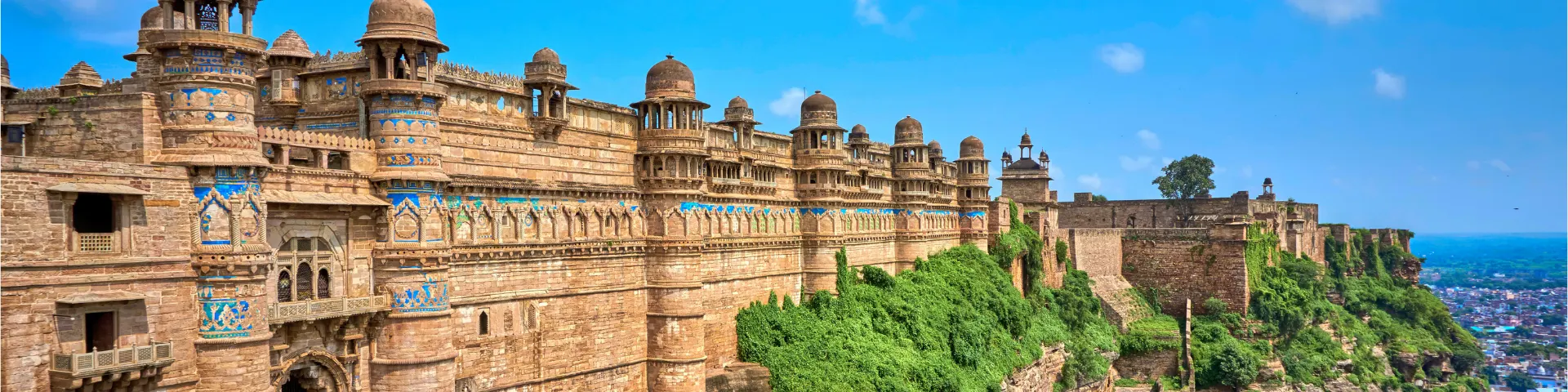
Gwalior gives the route its strongest first impression. The fort rises above the city on a sandstone plateau and contains several distinct chapters rather than one single monument.
Man Mandir Palace stands out for its coloured tilework, courtyards and palace interiors. Gujari Mahal now houses an archaeological museum. The wider complex also includes temples, later palaces and large Jain figures carved into the rock along the approach.
Gwalior also carries a major musical identity. Its association with Tansen remains central to the city, and UNESCO recognises Gwalior as a Creative City of Music.
Two nights work well. They allow a proper fort visit, time for another part of the city and a calmer arrival before the route continues.
Why should Orchha be more than a brief stop?
Orchha changes the pace of the journey.
Jahangir Mahal gives the palace complex its scale. Raja Mahal adds painted interiors and a more intimate court setting. Chaturbhuj Temple rises above the town, while Ram Raja Temple remains an active place of worship. The cenotaphs beside the Betwa River are strongest when the light softens and the day visitors begin to leave.
A short stop can cover the main names. An overnight stay allows the town, river and monuments to work together.
Orchha has a smaller hotel inventory than Gwalior or Khajuraho. The route is strongest when travellers accept one character-led night and choose the destination for its setting and architecture rather than uniform hotel standards.
What makes Khajuraho different?
Khajuraho brings the route into a closer study of temple architecture and sculpture.
The surviving Hindu and Jain temples date mainly from the 10th and 11th centuries. The Western Group contains the best-known and most concentrated examples, while the Eastern Group adds important Jain temples and a quieter second layer.
The temples should not be reduced to a small part of their erotic sculpture. Their exterior programmes also include deities, musicians, dancers, couples, warriors, animals and scenes of courtly and everyday life.
A strong guide first explains the platforms, towers and proportions, then moves towards the detail. This keeps the visit clear without making it either sensational or overly academic.
Two nights give Khajuraho enough time for the main temple group, a second visit or museum, and a measured final day. Travellers who want wildlife can connect the route with Panna or Farbound’s Central India tiger safari.
How many days does a Central India heritage route need?
Five nights create the strongest core route:
- Two nights in Gwalior
- One night in Orchha
- Two nights in Khajuraho
Four nights can work, but one destination will feel compressed. Six nights suit travellers with a deeper interest in architecture, photography or religious history, or those adding Panna.
The aim is not to lengthen the journey without reason. It is to prevent three substantial destinations from competing for attention inside too little time.
What is the best order for Gwalior, Orchha and Khajuraho?
For many journeys, the clearest order is Gwalior, Orchha and Khajuraho.
Gwalior has stronger arrival access than Orchha. The route then continues by road to Orchha and onwards to Khajuraho. This sequence also creates a natural progression from fort and royal city to riverside Bundela architecture and then to the Chandella temple landscape.
The reverse order can work when flights, trains or the wider India route make it more efficient. Khajuraho can also connect with Panna, Bandhavgarh or Varanasi.
Access should decide the final order. A good narrative is useful, but not at the cost of unnecessary travel.
Who will value this route most?
This route suits travellers who want architecture and history to carry the journey.
It works particularly well for interests in forts, temple design, sculpture, archaeology, photography, religious history and Indian classical music. It can suit both first-time and repeat visitors, provided the wider trip leaves enough time for a focused Central India chapter.
The route involves walking, uneven surfaces and stairs. Gwalior Fort covers a large area, Orchha rewards movement between monuments, and Khajuraho is best understood on foot. Daily planning should reflect the traveller’s mobility and comfort.
When is the best time to visit Gwalior, Orchha and Khajuraho?
October to March is the most comfortable period for a Central India heritage route.
Cooler days make long fort and temple visits easier. December and January can bring cold mornings and evenings, while February often gives a useful balance of temperature and daylight.
March becomes warmer. Summer heat can sharply reduce the quality of outdoor visits. The monsoon brings greener landscapes and a fuller Betwa River, but travellers need to accept humidity, rain and changing road conditions.
How should a private Central India journey be planned?
The route depends on strong guiding, honest travel times and selective days.
Gwalior needs a guide who can organise a large, layered fort complex. Orchha needs context that connects the palace, town, river and active temples. Khajuraho needs interpretation that explains architecture before individual carvings.
Not every hour should be filled. Gwalior can make the first full day demanding. Orchha should slow the route. Khajuraho requires concentration, and too many temple visits in one session can blur together.
Hotel standards also vary. The best plan uses the strongest available stay in each place without pretending that the inventory is identical across the route.
Central India works when Gwalior, Orchha and Khajuraho receive distinct roles. Together, they create a clear journey through fort, court, river, temple and town.
For a wider regional route, Farbound’s guide to Kanha and Pench tiger safaris shows how Central India’s heritage can connect with its wildlife.
Good to know
Sources
- Farbound Travels — title, excerpt and guide content supplied in this row
Written by Salil Tiwari.
Published July 2026 · Last updated September 2026
Keep reading
Luxury Golden Triangle India: What Is Actually Worth Upgrading?
A high-end Golden Triangle trip is not improved by upgrading every line item. Here is where bet...
Best Tiger Safari in India: Ranthambore, Bandhavgarh, Kanha, Pench or Tadoba?
The best tiger safari in India depends on route, season and how many drives you can give it. Co...