
In short
An honest comparison of private, small-group and independent travel across India, Nepal, Bhutan and Sri Lanka, including cost, daily pace and who each format genuinely suits.
At a glance
- Private travel
- Vehicle, driver, guide, dates and daily timing run for your party alone
- Cost structure
- Private travel costs more per person because fixed operating costs are shared by fewer people
- Independent travel
- Best suited to repeat visitors or trips built around staying in one place
- Small groups
- Often stronger value for solo travellers and people comfortable with fixed dates and group pacing
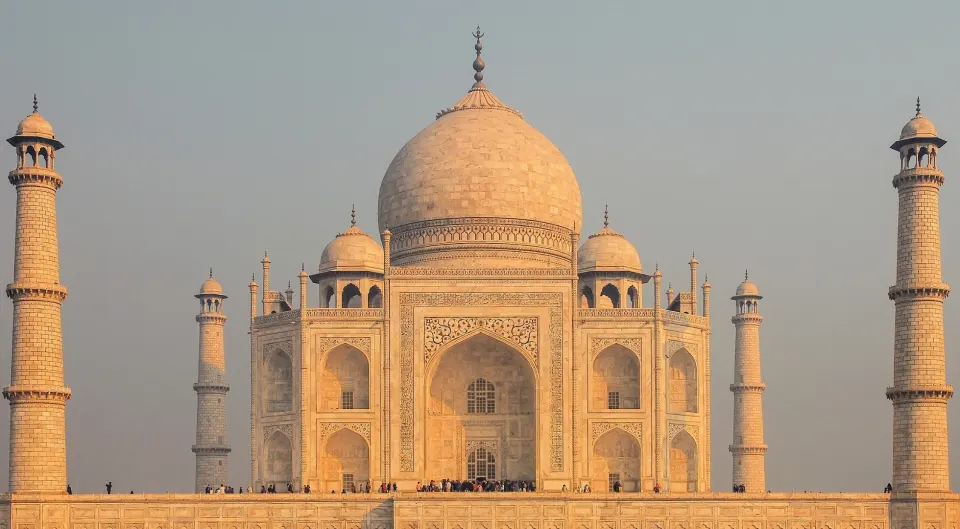
The Taj Mahal is closed on Fridays. Ranthambore releases its safari seats in two fixed slots a day, allocated by zone and booked well ahead of arrival. Bhutan charges its Sustainable Development Fee per person per night no matter how you travel, USD 100 for most nationalities and INR 1,200 for Indian nationals. Nepal issues restricted-area trekking permits only through a registered agency.
Those constraints exist regardless of which company you book, or whether you book one at all. What changes between private travel, a small-group departure and independent travel is who absorbs them, how much of your day they occupy, and what a change of plan costs you in time and money.
All three formats work in this region. They suit different travellers, different trip lengths and different budgets, and plenty of people use more than one on the same trip. This piece sets out what each format actually is, what each one costs, and who it genuinely fits, so the decision can be made before you start comparing itineraries.
What each format actually means
The three words are used loosely, so it is worth fixing definitions before comparing anything.
Private travel means the trip runs for your party alone. Your vehicle, your driver, your guide, your departure date, your daily start time. The itinerary is designed for you and can be changed while you are travelling. Nobody else is in the vehicle and nobody else's preferences shape the day.
Small-group travel means a fixed departure date with a published itinerary, shared with other travellers who booked the same trip. The route and timings are set in advance because they have to work for everyone. Group sizes vary widely by operator, and the number is worth asking for in writing rather than inferring from the word "small".
Independent travel means you plan and book the components yourself: flights, hotels, transport, guides and entry tickets. You may still use local drivers or day guides, but no company holds the plan or carries responsibility for it.
What actually changes day to day
The format decision is usually presented as a question of comfort. In this region it is mostly a question of timing and access.
Most of the best experiences across the subcontinent are time-bound. The Taj at first light, before the coach arrivals, is a different building from the Taj at eleven. Safari slots at Ranthambore, Kanha and Yala are fixed and finite. Old Delhi is a different city at seven in the morning than at noon. Monasteries in Bhutan and Ladakh hold their prayer sessions to their own schedule, not a tour schedule. A festival day moves by the lunar calendar and changes what is possible in a whole town.
Private travel converts those into choices you can make on the day. A group itinerary makes them in advance, for everyone, and generally lands on the compromise that works for a mixed party. Independent travel gives you the freedom and asks you to do the research, hold the tickets and absorb the queue.
The second daily difference is recovery time. Long drives and internal flights are unavoidable on most subcontinent routes, and how a day is put back together after a delayed flight or a closed road is where the formats separate most visibly.
What each one costs, honestly
Private travel costs more per person than a group departure on the same route, and any comparison that hides this is not worth reading.
The reason is structural rather than mysterious. A vehicle, a driver and a guide cost roughly the same whether two people or fourteen are using them. On a group departure those fixed costs divide across the group. On a private trip they divide across your party alone, which is why private travel for two carries a much higher per-person premium than private travel for six, and why the same journey drops in per-person price as your party grows.
Farbound's listed journeys run from around USD 1,500 to USD 7,950 per person on double occupancy, before international flights, across trips of five to eighteen days. The spread comes from length, route and hotel tier rather than from a different standard of trip. Our Classic and Signature tiers keep the same route, private transport and guiding, and differ in the hotels and room categories, so the cost question is a choice you make rather than a fixed floor you clear.
Independent travel is the cheapest in cash and the most expensive in your own hours. The planning work for a two-week subcontinent route is real: permits, internal flights that sell out in peak months, hotel locations that look adjacent on a map and are forty minutes apart in traffic, entry ticketing that varies by site. Some travellers enjoy that work. It is genuinely part of the trip for them.
Who small-group travel suits better
Group departures are often written about as the compromise option. For several kinds of traveller they are the better product, and it is worth saying so plainly.
Solo travellers are the clearest case. A private trip for one carries the full fixed cost with nobody to share it, while a group departure removes both the premium and the evenings alone. The single supplement on a group trip is usually far smaller than the difference between one-person and two-person private pricing.
First trips to the region where the appeal is the company as much as the country also fit well. So do specialist departures built around a guest expert, a photography leader or a naturalist, where the point is the person leading it and the shared knowledge in the vehicle. And for travellers who want the decision made for them, a published itinerary with published dates removes a layer of choice that some people find genuinely tiring.
The honest trade is fixed timings, a shared pace, and limited ability to change anything once the trip has begun.
Who independent travel suits better
Independent travel suits repeat visitors and anyone whose trip is built around staying still.
If you are spending two weeks in one place, a wellness stay in Kerala, a language or yoga course in Rishikesh, a long stretch in Colombo or Kathmandu with day trips out, the coordination burden is small and an operator adds less. The same applies if you already know the region, have your own contacts, and are travelling to a short list of familiar places.
Where independent travel gets harder is multi-city routes in peak season, anything involving permits or park allocations, and any itinerary where a single missed connection cascades through the following week. It is also harder in the months where weather actively reshapes routes, and in festival periods when a whole city's accommodation and movement pattern changes.
A common and sensible pattern is to mix: run the logistically dense stretch privately, then travel independently for the stationary part at the end. We build trips like this regularly and it is a reasonable thing to ask any operator for.
Where private travel earns its cost in South Asia
The premium is easiest to justify in four specific situations, and it is worth checking whether your trip contains any of them.
The first is dense multi-city routes. A Rajasthan circuit or a Delhi to Kochi route puts a new city, a new hotel and a new set of logistics into most days. The value of private travel rises with the number of moving parts.
The second is permits and allocations. Restricted-area permissions in Nepal, safari zone allocations across Indian parks, and the licensed-operator requirement in Bhutan all reward having a company that does this weekly rather than once.
The third is guiding depth. India licenses its guides by region and by language, and the difference between a licensed regional guide who knows a site properly and a general escort is the difference between a monument and a story. On a private trip you can hold a guide for a full day and go at the pace of your own interest.
The fourth is anything with a personal shape to it: a family trip with different energy levels across three generations, an anniversary, a first visit built around one specific thing you have wanted to see for years. Those trips are difficult to buy off a published departure list because the thing that makes them work is the part that was designed for you.
How to decide in one pass
Three questions usually settle it.
How many are travelling? At four or more, private pricing per person closes much of the gap to a group departure and the case becomes straightforward. At one, a group departure is often the better trip as well as the cheaper one.
How many places are you moving between? Under three in two weeks, independent travel is very manageable. Above five, the coordination is a job, and it is worth deciding whether you want it.
What would ruin the trip for you? If the answer is being rushed past the thing you came for, private. If it is eating dinner alone for two weeks, group. If it is feeling managed, independent, or a private trip with deliberately loose days built in, which is a request we take often.
If you are still weighing two quotes from different companies after that, the questions that separate them are set out in our guide on how to choose a private South Asia tour company.
Tell us how you travel and we will reply within one business day
Good to know
Sources
- Farbound Travels — title, excerpt and guide content supplied in this row
Written by Salil Tiwari.
Published August 2026 · Last updated September 2026
Keep reading
Why Farbound Works Both Directly With Travellers and Through Travel Advisors
Farbound works with travellers directly and with travel advisors because the booking relationsh...

Is Private Travel Actually Worth the Extra Cost?
Private travel costs more per person than a group departure. The useful question is when contro...